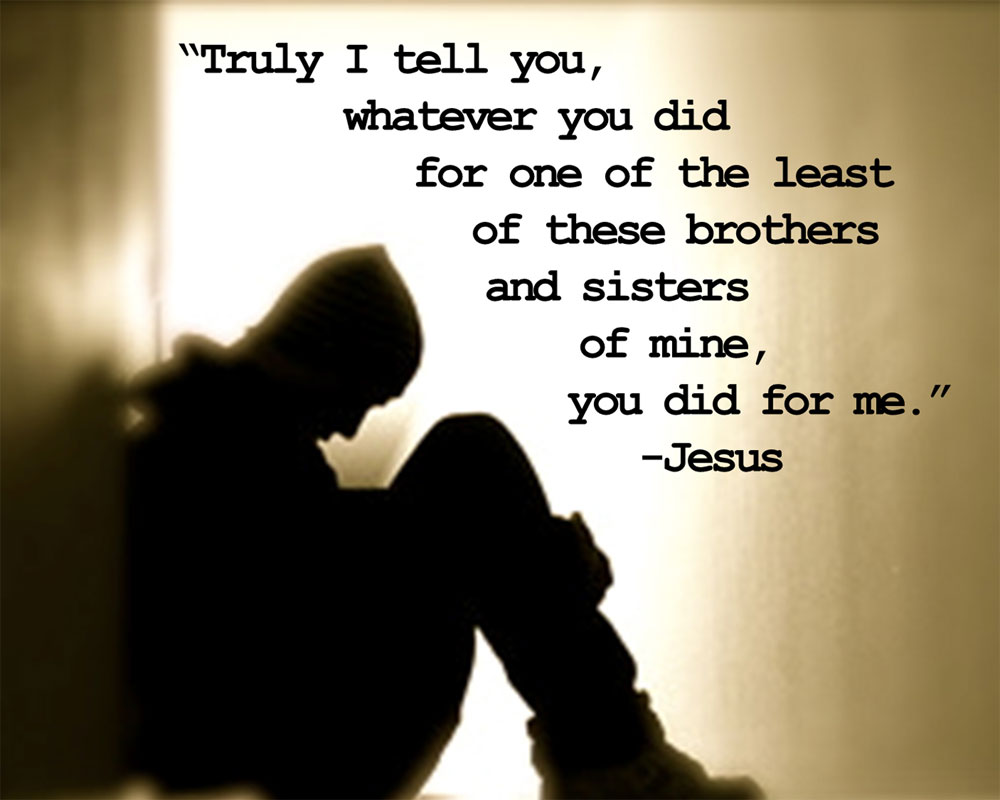
Today I am deviating a little from my usual contemplation prompted by an article I read this morning. It reminded me of the importance of compassion and empathy for those in situations we can’t personally fathom. True compassion is more than a feeling, it prompts us to action. We saw this in our Savior Jesus.
When he went ashore he saw a great crowd, and he had compassion on them and healed their sick. Matthew 14:14
So Jesus had compassion and touched their eyes. And immediately their eyes received sight, and they followed Him. Matthew 20:34
Now a leper came to Him, imploring Him, kneeling down to Him and saying to Him, “If You are willing, You can make me clean.” Then Jesus, moved with compassion, stretched out His hand and touched him, and said to him, “I am willing; be cleansed.” Mark 1:40-41
Jesus, moved by compassion for the “least of these”, always acted to meet physical needs of others. If we are to be followers of Jesus it compels us to do the same. In that spirit, I would like to share excepts from the article that moved me this morning. Click here if you would like to read the whole article. The article was an eye-opening, first-hand account of the treatment of those detained by the US Immigration system. The process started after the writer had gone voluntarily to the Immigration office to re-apply for a work visa.
Then she said something strange: “You didn’t do anything wrong. You are not in trouble, you are not a criminal.” I remember thinking: Why would she say that? Of course I’m not a criminal! She then told me they had to send me back to Canada. That didn’t concern me; I assumed I would simply book a flight home. But as I sat searching for flights, a man approached me.
“Come with me,” he said. There was no explanation, no warning. He led me to a room, took my belongings from my hands and ordered me to put my hands against the wall. A woman immediately began patting me down. The commands came rapid-fire, one after another, too fast to process. They took my shoes and pulled out my shoelaces.
“What are you doing? What is happening?” I asked.
“You are being detained.”
“I don’t understand. What does that mean? For how long?”
“I don’t know.”
That would be the response to nearly every question I would ask over the next two weeks: “I don’t know.”
Her detention came without warning. In the matter of moments, she was transformed from a Visa applicant to a convict. someone looking to work in the United States to She makes clear that the experience is not an isolated event but one shared by all non-criminal detainees.
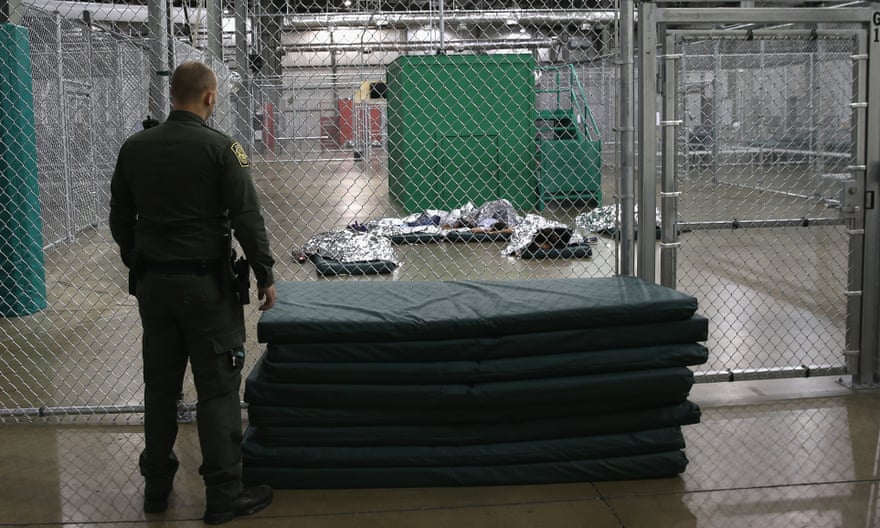
They handed me a mat and a folded-up sheet of aluminum foil. I was taken to a tiny, freezing cement cell with bright fluorescent lights and a toilet. There were five other women lying on their mats with the aluminum sheets wrapped over them, looking like dead bodies. The guard locked the door behind me. For two days, we remained in that cell, only leaving briefly for food. The lights never turned off, we never knew what time it was and no one answered our questions.
Then they moved me to another cell – this time with no mat or blanket. I sat on the freezing cement floor for hours. That’s when I realized they were processing me into real jail: the Otay Mesa Detention Center. I was told to shower, given a jail uniform, fingerprinted and interviewed. I begged for information.
“How long will I be here?”
“I don’t know your case,” the man said. “Could be days. Could be weeks. But I’m telling you right now – you need to mentally prepare yourself for months.”
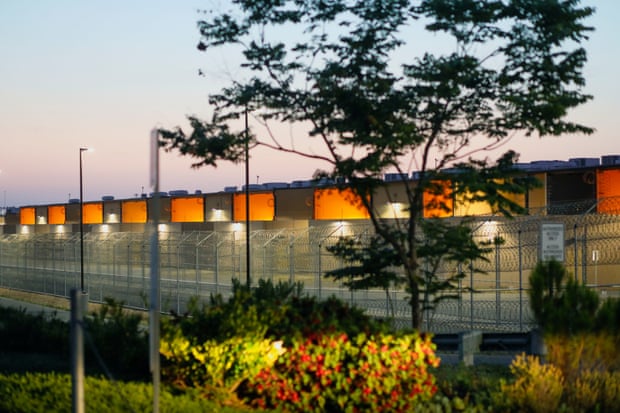
During her time at the Otay Mesa Detention Center, she heard the stories of the other women, some who had been detained as long as 10 months.
And that’s when I made a decision: I would never allow myself to feel sorry for my situation again. No matter how hard this was, I had to be grateful. Because every woman I met was in an even more difficult position than mine. There were around 140 of us in our unit. Many women had lived and worked in the US legally for years but had overstayed their visas – often after reapplying and being denied. They had all been detained without warning.
I met a woman who had been on a road trip with her husband. She said they had 10-year work visas. While driving near the San Diego border, they mistakenly got into a lane leading to Mexico. They stopped and told the agent they didn’t have their passports on them, expecting to be redirected. Instead, they were detained. They are both pastors.
I met a family of three who had been living in the US for 11 years with work authorizations. They paid taxes and were waiting for their green cards. Every year, the mother had to undergo a background check, but this time, she was told to bring her whole family. When they arrived, they were taken into custody and told their status would now be processed from within the detention center.
The only thing harder than an unknown period of detention, in which they were treated like criminals, was the constant moving and relocation.
Our next stop was Arizona, the San Luis Regional Detention Center. The transfer process lasted 24 hours, a sleepless, grueling ordeal. This time, men were transported with us. Roughly 50 of us were crammed into a prison bus for the next five hours, packed together – women in the front, men in the back. We were bound in chains that wrapped tightly around our waists, with our cuffed hands secured to our bodies and shackles restraining our feet, forcing every movement into a slow, clinking struggle.
When we arrived at our next destination, we were forced to go through the entire intake process all over again, with medical exams, fingerprinting – and pregnancy tests; they lined us up in a filthy cell, squatting over a communal toilet, holding Dixie cups of urine while the nurse dropped pregnancy tests in each of our cups.
I kept telling myself: Do not let this break you.
-Jasmine Mooney
Thirty of us shared one room. We were given one Styrofoam cup for water and one plastic spoon that we had to reuse for every meal. I eventually had to start trying to eat and, sure enough, I got sick. None of the uniforms fit, and everyone had men’s shoes on. The towels they gave us to shower were hand towels. They wouldn’t give us more blankets. The fluorescent lights shined on us 24/7. Everything felt like it was meant to break you. Nothing was explained to us. I wasn’t given a phone call. We were locked in a room, no daylight, with no idea when we would get out.
This description of the treatment of detainees should break your heart. In America, “the home of the free”, vulnerable people have been stripped of their rights, their dignity, and their basic humanity. Yet, even in dark and desperate places the light of Jesus can still shine bright. Even brief interactions provided opportunities for hope.
I was taken to the nurse’s office for a medical check. She asked what had happened to me. She had never seen a Canadian there before. When I told her my story, she grabbed my hand and said: “Do you believe in God?”
I told her I had only recently found God, but that I now believed in God more than anything.
“I believe God brought you here for a reason,” she said. “I know it feels like your life is in a million pieces, but you will be OK. Through this, I think you are going to find a way to help others.”
At the time, I didn’t know what that meant. She asked if she could pray for me. I held her hands and wept. I felt like I had been sent an angel.
Finding a community of believers provided an opportunity to lift each other up with prayers and support.
That night, the pastor invited me to a service she was holding. A girl who spoke English translated for me as the women took turns sharing their prayers – prayers for their sick parents, for the children they hadn’t seen in weeks, for the loved ones they had been torn away from. Then, unexpectedly, they asked if they could pray for me. I was new here, and they wanted to welcome me. They formed a circle around me, took my hands and prayed. I had never felt so much love, energy and compassion from a group of strangers in my life. Everyone was crying.
We were from different countries, spoke different languages and practiced different religions. Yet, in this place, none of that mattered. Everyone took care of each other. Everyone shared food. Everyone held each other when someone broke down. Everyone fought to keep each other’s hope alive.
What can we take away from a story like this? We cannot allow politics to impede compassion. Love is a fundamental part of Christianity. Jesus’s love is revolutionary. He offers grace to all regardless of our past mistakes or personal worth. The love of Jesus isn’t confined by borders, and it breaks through every boundary.
For I am convinced that neither death nor life, neither angels nor demons, neither the present nor the future, nor any powers, neither height nor depth, nor anything else in all creation, will be able to separate us from the love of God that is in Christ Jesus our Lord. Romans 8:38-39
We may feel helpless to correct this injustice, but we can choose to stand up for those in our own communities. Right now the hands and feet of Jesus are needed in our communities more than ever. How can we display our compassion through action? What can we do to help the least of these?
 Seek and You Will Find
What a beautiful event
Thank you for sharing
LikeLike